【设计模式】组件协作
作者:wallace-lai
发布:2024-04-02
更新:2024-06-05
现代软件专业分工之后的第一个结果是框架与应用程序的划分,组件协作模式通过晚期绑定,来实现框架与应用程序之间的松耦合,是二者之间协作时常用的模式。
组件协作的典型模式:
(1)Template Method
(2)Strategy
(3)Observer/Event
一、模板方法
1.1 动机
在软件构建过程中,对于某一项任务,它常常有稳定的整体结构,但各个子步骤却有很多改变的需求。或者由于固有的原因(比如框架与应用之间的关系)而无法和任务的整体结构同时实现。
如何在确定稳定操作结构的前提下,来灵活应对各个子步骤的变化或者晚期实现的需求?
1.2 定义
模板方法:模板方法定义一个操作中的算法的骨架(稳定),而将一些步骤延迟到子类中。模板方法使得子类可以不改变(复用)一个算法的结构即可重定义(override重写)该算法的某些特定步骤。
下面是一个采用结构化设计思想的案例:
// 程序库开发人员
// 程序库只提供了稳定的Step1(), Step3()和Step5()方法的实现
// 程序主流程和Step2()以及Step4()方法均由应用程序实现。由于
// 程序主流程依赖了程序库的Step1(), Step3()和Step5()方法
// 所以这是个应用程序依赖程序库的早绑定方式。
class Library {
public:
	void Step1() {
		// ...
	}

	void Step3() {
		// ...
	}

	void Step5() {
		// ...
	}
};
// 应用程序开发人员
class Application {
public:
	bool Step2() {
		// ...
	}

	void Step4() {
		// ...
	}
};

// 主流程
int main() {
	Library lib();
	Application app();

	lib.Step1();

	if (app.Step2()) {
		lib.Step3();
	}

	for (int i = 0; i < 4; ++i) {
		app.Step4();
	}

	lib.Step5();
	return 0;
}
对于上述结构化软件设计案例,可以用图来表示:
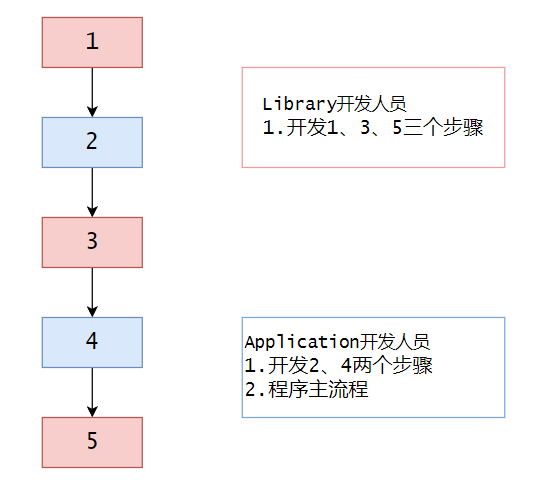
可以看到上述结构化软件设计案例中,是应用程序依赖了库函数,这是早绑定的。
应用模板方法,可以将上面的例子设计成以下的形式:
// 程序库开发人员
// 程序主流程Run和Step1(), Step2(), Step3()方法是稳定的
// 稳定的东西由程序库来实现,需要容纳变化的Step2和Step4()方
// 法采用虚函数的方式应用程序人员提供实现。这样就实现了晚绑定
class Library {
public:
	// 流程也是稳定的,所以应该由程序库提供
	void Run() {
		Step1();

		// 支持变化,虚函数的多态调用
		if (Step2()) {
			Step3();
		}

		// 支持变化,虚函数的多态调用
		for (int i = 0; i < 4; ++i) {
			Step4();
		}

		Step5();
	}

	virtual ~Library() {}

protected:
	void Step1() {	// 稳定
		// ...
	}

	void Step3() {	// 稳定
		// ...
	}

	void Step5() {	// 稳定
		// ...
	}

	virtual bool Step2() = 0;	// 变化
	virtual void Step4() = 0;	// 变化
};
// 应用程序开发人员需要重写父类的虚函数
class Application : public Library {
protected:
	virtual bool Step2() {
		// ...子类重写实现
	}

	virtual void Step4() {
		// ...子类重写实现
	}
};

// 使用程序库
int main() {
	Library *pLib = new Application();
	pLib->Run();

	delete pLib;
}
1.3 注意
(1)模板方法的结构如下所示,其中红色的部分是稳定的,蓝色是变化的部分;
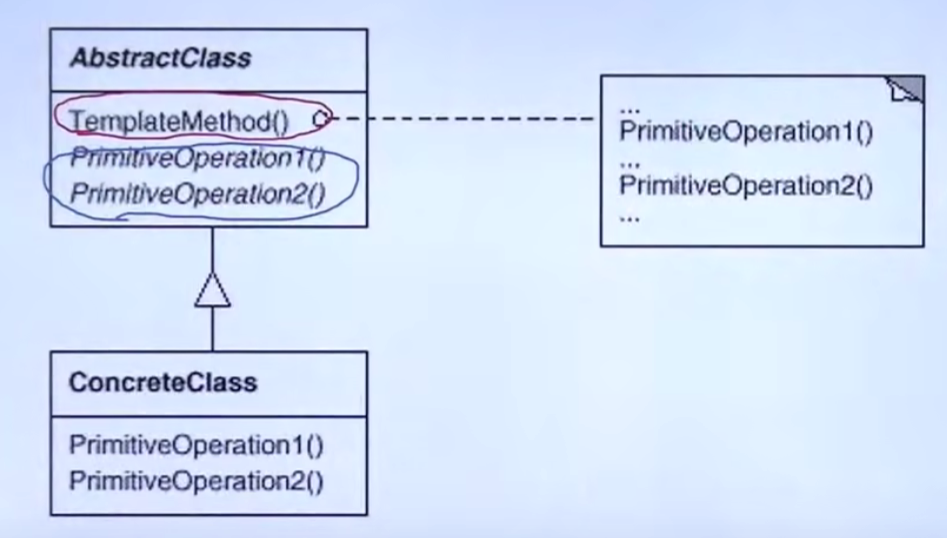
(2)模板方法模式成立的前提是算法骨架(Run方法)是稳定的。如果算法骨架都不是稳定的,那么它就不适合用模板方法方法;
(3)如果所有步骤都是稳定不变的(极端情况下),那么就没有使用设计模式的必要了。设计模式的意义在于在变化(部分)和稳定(部分)之间寻找隔离点,从而管理变化;
(4)稳定和变化是相对的,没有绝对不变的东西,只有某部分代码相对其他代码更稳定一点;
1.4 总结
(1)模板方法模式是一种非常基础性的设计模式,在面向对象系统中有着大量的应用。它用最简洁的机制(虚函数的多态性)为很多应用程序框架提供了灵活的扩展点,是代码复用方面的基本实现结构。
(2)除了可以灵活地应对子步骤的变化外,“不要调用我,让我调用你”的反向控制结构是模板方法的典型应用。“不要调用我,让我调用你”,即你应用程序不要调用我程序库,让我来调用你。
(3)在具体实现方面,被模板方法调用的虚方法可以具有实现,也可以没有任何实现(抽象方法、纯虚方法),但一般推荐将它们设计为protected方法,不供外界调用。
二、策略模式
2.1 动机
在软件构建过程中,某些对象使用的算法可能多种多样,经常改变,如果将这些算法都编码到对象中,将会使对象变得异常复杂。而且有时候支持不使用的算法也是一个性能负担。
如何在运行时根据需要透明地更改对象的算法?将算法与对象本身解耦,从而避免上述问题?
2.2 定义
策略模式:定义一系列算法,把它们一个个封装起来,并且使它们可互相替换(变化)。该模式使得算法可独立于使用它的客户程序(稳定)而变化(扩展、子类化)。
如下所示,有同样功能的两段代码。
不使用策略模式:
enum TaxBase {
	CN_TAX,
	US_TAX,
	DE_TAX,
	FR_TAX	// 更改
};

class SalesOrder {
	TaxBase tax;

public:
	double CalculateTax() {
		// ...
		if (tax == CN_TAX) {
			// ...
		}
		else if (tax == US_TAX) {
			// ...
		}
		else if (tax == DE_TAX) {
			// ...
		}
		else if (tax == FR_TAX) {	// 更改
			// ...
		}
	}
};
不使用策略模式存在的问题:
(1)假如要新增FR_TAX类型的税种计算,那么就会产生更改。这违背了开闭原则
使用策略模式:
class TaxStrategy {
public:
	virtual double Calculate(const Context& context) = 0;
	virtual ~TaxStrategy() {}
};

class CNTax : public TaxStrategy {
public:
	virtual double Calculate(const Context& context) {
		// ...
	}
};

class USTax : public TaxStrategy {
public:
	virtual double Calculate(const Context& context) {
		// ...
	}
};

class DETax : public TaxStrategy {
public:
	virtual double Calculate(const Context& context) {
		// ...
	}
};

// 添加而非更改
class FRTax : public TaxStrategy {
public:
	virtual double Calculate(const Context& context) {
		// ...
	}
};

class SalesOrder {
private:
	TaxStrategy* strategy;

public:
	SalesOrder(StrategyFactory* strategyFactory) {
		this->strategy = strategyFactory->NewStrategy();
	}

	~SalesOrder() {
		delete this->strategy;
	}

	public double CalculateTax() {
		// ...
		Context context();
		// 多态调用
		double val = strategy->Calculate(context);
		// ...
	}
};
使用策略模式的好处:
(1)假如要新增FR_TAX类型的税种计算,那么只需要进行扩展而无需进行更改;
(2)上述代码的可复用性得到了提升;
2.3 总结
(1)策略模式的结构图如下,其中红色是稳定部分,蓝色为变化部分;

(2)Strategy及其子类为组件提供了一系列可重用的算法,从而可以使得类型在运行时方便地根据需要在各个算法之间进行切换;
(3)Strategy模式提供了用条件判断语句以外的另一种选择,消除条件判断语句,就是在解耦合。含有许多条件判断语句的代码通常需要Strategy模式;
(4)如果Strategy对象没有实例变量,那么各个上下文可以共享同一个Strategy对象,从而节省对象开销;
三、观察者模式
3.1 动机
在软件构建过程中,我们需要为某些对象建立一种“通知依赖关系”——一个对象(目标对象)的状态发生改变,所有依赖对象(观察者对象)都将得到通知。如果这样的依赖关系过于紧密,将使得软件不能很好地抵御变化。
使用面向对象的技术,可以将这种依赖关系弱化,并形成一种稳定的依赖关系。从而实现软件体系结构的松耦合。
3.2 模式定义
观察者模式:定义对象间的一种一对多(变化)的依赖关系,以便当一个对象(Subject)的状态发生改变时,所有依赖于它的对象(Observer)都得到通知并自动更新。
假如我们要做一个文件分割器的小软件,它的初始源码可以是以下的形式。此时,还不涉及到观察者模式。
class FileSplitter {
    string filePath;
    int fileNumber;

public:
    FileSplitter(const string &filePath, int num) :
        filePath(filePath), fileNumber(num) {}

    void split(void) {
        // 1. 读取大文件

        // 2. 分批次向小文件中写入
        for (int i = 0; i < fileNumber; i++) {
            // ...
        }
    }
};

class MainForm : public Form
{
    TextBox *txtFilePath;
    TextBox *txtFileNumber;

public:
    void Button1_Click() {
        string filePath = txtFilePath->getText();
        int number = atoi(txtFileNumber->getText().c_str());

        FileSplitter splitter(filePath, number);
        splitter.split();
    }
};
假如要添加一个进度条的功能,最简单的方法是如下的写法。
class FileSplitter {
    string filePath;
    int fileNumber;
    ProgressBar *progressBar;   // 新增

public:
    FileSplitter(const string &filePath, int num, ProgressBar *progress) :
        filePath(filePath), fileNumber(num), progressBar(progress) {}

    void split(void) {
        // 1. 读取大文件

        // 2. 分批次向小文件中写入
        for (int i = 0; i < fileNumber; i++) {
            // ...

            // 新增
            if (progressBar != nullptr) {
                progressBar->setValue((i + 1) / fileNumber);
            }
        }
    }
};

class MainForm : public Form
{
    TextBox *txtFilePath;
    TextBox *txtFileNumber;

    ProgressBar *progress;  // 新增

public:
    void Button1_Click() {
        string filePath = txtFilePath->getText();
        int number = atoi(txtFileNumber->getText().c_str());

        // 更改
        FileSplitter splitter(filePath, number, progress);
        splitter.split();
    }
};
上述代码存在什么问题?
它违反了依赖倒置原则,即抽象不应该依赖于实现细节,实现细节应该依赖于抽象。FileSplitter中新增的progressBar就是实现细节。一旦提示的形式变了(这是很容易发生的),不再是进度条了,那么上述代码就需要跟着变动。
仔细分析一下,progressBar在代码起到的作用是通知,如何用一种更加抽象的机制来起到通知的功能呢?下面的代码就不再违反依赖倒置原则了,原因在于FilterSplitter由原来的依赖具体ProgressBar类变成了依赖抽象的通知机制IProgress。
此时的代码是只有一个观察者的观察者模式,观察者对象是MainForm,目标对象是FileSplitter。
// 抽象的通知机制
class IProgress {
public:
    virtual void DoProgress(float value) = 0;
    virtual ~IProgress() {}
};

class FileSplitter {
    string filePath;
    int fileNumber;
    // ProgressBar *progressBar;  // 具体的通知控件
    IProgress *progress;    // 抽象的通知机制

public:
    FileSplitter(const string &filePath, int num, IProgress *progress) :
        filePath(filePath), fileNumber(num), progress(progress) {}

    void split(void) {
        // 1. 读取大文件

        // 2. 分批次向小文件中写入
        for (int i = 0; i < fileNumber; i++) {
            // ...

            // 新增
            if (progress != nullptr) {
                float value = (i + 1) / fileNumber;
                progress->DoProgress(value);
            }
        }
    }
};

// 主继承 + 接口的继承形式
class MainForm : public Form, public IProgress
{
    TextBox *txtFilePath;
    TextBox *txtFileNumber;

    ProgressBar *progress;  // 新增

public:
    void Button1_Click() {
        string filePath = txtFilePath->getText();
        int number = atoi(txtFileNumber->getText().c_str());

        // 更改
        FileSplitter splitter(filePath, number, this);
        splitter.split();
    }

    virtual void DoProgress(float value) {
        progress->setValue(value);
    }
};
但是,如果需要有多个观察者对象又该怎么办呢?上述的代码显然就不好支持多个观察者对象了。此时就需要进行多观察者改造了,具体代码如下。至此,终于得到了完整的观察者模式代码。
// 抽象的通知机制
class IProgress {
public:
    virtual void DoProgress(float value) = 0;
    virtual ~IProgress() {}
};


class FileSplitter {
    string filePath;
    int fileNumber;
    // ProgressBar *progressBar;  // 具体的通知控件
    // IProgress *progress;    // 抽象的通知机制
    list<IProgress*> progress;  // 观察者列表,支持多个观察者

public:
    FileSplitter(const string &filePath, int num) :
        filePath(filePath), fileNumber(num) {}

    // 添加观察者
    void AddIProgress(IProgress *i) {
        progress.add(i);
    }

    // 移除观察者
    void RemoveIProgress(IProgress *i) {
        progress.remove(i);
    }

    // 移除观察者
    void split(void) {
        // 1. 读取大文件

        // 2. 分批次向小文件中写入
        for (int i = 0; i < fileNumber; i++) {
            // ...

            float value = (i + 1) / fileNumber;
            OnProgress(value);
        }
    }

protected:
    void OnProgress(float value) {
        list<IProgress*>::iterator iter = progress.begin();
        while (iter != progress.end()) {
            (*iter)->DoProgress(value);
        }
    }
};

// 主继承 + 接口的继承形式
class MainForm : public Form, public IProgress
{
    TextBox *txtFilePath;
    TextBox *txtFileNumber;

    ProgressBar *progressBar;  // 新增

public:
    void Button1_Click() {
        string filePath = txtFilePath->getText();
        int number = atoi(txtFileNumber->getText().c_str());

        ConsoleNotifier cn;

        FileSplitter splitter(filePath, number);
        splitter.AddIProgress(this);
        splitter.AddIProgress(&cn);

        splitter.split();

        splitter.RemoveIProgress(&cn);
        splitter.RemoveIProgress(this);
    }

    virtual void DoProgress(float value) {
        progressBar->setValue(value);
    }
};

class ConsoleNotifier : public IProgress {
public:
    virtual void DoProgress(float value) {
        cout << ".";
    }
};
3.3 要点总结
(1)观察者模式的结构如下所示,红色部分为稳定部分,蓝色部分为不稳定部分。
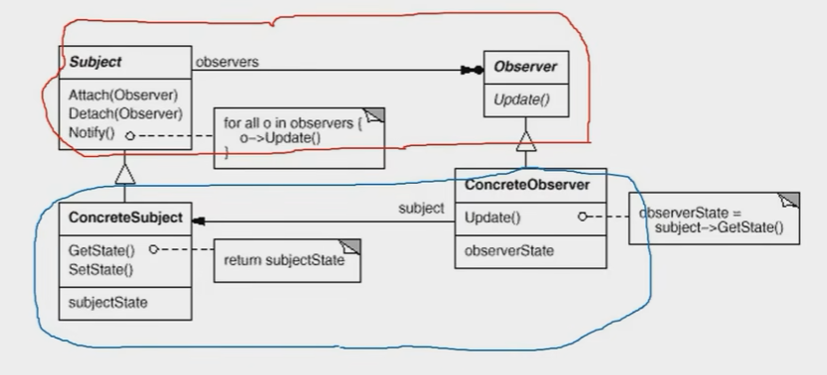
Subject为目标对象,其中的Attach表示往其中新增观察者,Detach表示移除观察者,Notify表示对所有的观察者进行通知。Observer为观察者对象。
(2)使用面向对象的抽象,Observer模式使得我们可以独立地改变目标与观察者,从而使二者之间的依赖关系达到松耦合。
(3)目标发送通知时,无需指定观察者,通知(可以携带通知信息作为参数)会自动传播。
(4)观察者自己决定是否需要订阅通知,目标对象对此一无所知。
(5)Observer模式是基于事件的UI框架中非常常用的设计模式,也是MVC模式的一个重要组成部分。
3.4 实践
手写观察者模式
// xxx_send_event.h

#ifndef XXX_SEND_EVENT_H_
#define XXX_SEND_EVENT_H_

// event type to send
typedef struct _xxx_event {
    int value;
} xxx_event;

// function to do real send task
typedef void (*xxx_send_func)(xxx_event *event);

// register observer id here
typedef enum _xxx_obsr_id {
    OBSR_ID_1,
    OBSR_ID_2,
    OBSR_ID_3,

    OBSR_ID_BUTT
} xxx_obsr_id;

int xxx_register_observer(xxx_obsr_id id, xxx_send_func func);
int xxx_unregister_observer(xxx_obsr_id id);

void xxx_send_event(void);

#endif /* XXX_SEND_EVENT_H_ */
// xxx_send_event.c

#include <stdio.h>
#include <assert.h>
#include "xxx_send_event.h"

#define ATTACH_TRUE  (1)
#define ATTACH_FALSE (0)

typedef struct _xxx_observer {
    int is_attach;
    xxx_send_func func;
} xxx_observer;

static xxx_observer g_obsr_table[OBSR_ID_BUTT];

int xxx_register_observer(xxx_obsr_id id, xxx_send_func func)
{
    if (id < 0 || id >= OBSR_ID_BUTT || func == NULL) {
        fprintf(stderr, "[ERROR] register observer failed due to invalid param.");
        return -1;
    }

    if (g_obsr_table[id].is_attach == ATTACH_TRUE) {
        fprintf(stderr, "[WARN] observer(id:%d) registered before, re-register now.", id);
    }

    g_obsr_table[id].is_attach = ATTACH_TRUE;
    g_obsr_table[id].func = func;

    return 0;
}

int xxx_unregister_observer(xxx_obsr_id id)
{
    if (id < 0 || id >= OBSR_ID_BUTT) {
        fprintf(stderr, "[ERROR] unregister observer(id: %d) failed due to invalid param", id);
        return -1;
    }

    if (g_obsr_table[id].is_attach == ATTACH_FALSE) {
        fprintf(stderr, "[WARN] observer(id:%d) unregistered before, re-unregister now.", id);
    }

    g_obsr_table[id].is_attach = ATTACH_FALSE;
    g_obsr_table[id].func = NULL;

    return 0;
}

void xxx_send_event(void)
{
    xxx_event event;
    xxx_send_func func;

    for (int i = 0; i < OBSR_ID_BUTT; i++) {
        if (g_obsr_table[i].is_attach == ATTACH_TRUE) {
            event.value = i;
            func = g_obsr_table[i].func;
            assert(func != NULL);
            func(&event);
        }
    }

    return;
}
注意:
(1)所有xxx的观察者都必须在xxx_obsr_id中注册其ID;
(2)在xxx的观察者注册发送函数时需要提供ID号和对应的函数指针;
(3)目标xxx通过xxx_send_event接口按照ID号的注册顺序依次进行通知;
// test.c

#include <stdio.h>
#include <stddef.h>
#include <assert.h>
#include "xxx_send_event.h"

void func1(xxx_event *event)
{
    assert(event != NULL);
    printf("Observer 1 received event(value:%d).\n", event->value);
}

void func2(xxx_event *event)
{
    assert(event != NULL);
    printf("Observer 2 received event(value:%d).\n", event->value);
}

void func3(xxx_event *event)
{
    assert(event != NULL);
    printf("Observer 3 received event(value:%d).\n", event->value);
}

int main()
{
    xxx_register_observer(OBSR_ID_1, func1);
    xxx_register_observer(OBSR_ID_2, func2);
    xxx_register_observer(OBSR_ID_3, func3);
    xxx_send_event();

    printf("------\n");

    xxx_unregister_observer(OBSR_ID_3);
    xxx_send_event();

    printf("------\n");

    xxx_unregister_observer(OBSR_ID_1);
    xxx_send_event();

    printf("------\n");

    xxx_register_observer(OBSR_ID_3, func3);
    xxx_send_event();

    return 0;
}
测试结果如下:
Observer 1 received event(value:0).
Observer 2 received event(value:1).
Observer 3 received event(value:2).
------
Observer 1 received event(value:0).
Observer 2 received event(value:1).
------
Observer 2 received event(value:1).
------
Observer 2 received event(value:1).
Observer 3 received event(value:2).